Hello, this is 200Invest.
Recently, one of the most frequently mentioned technologies in the AI semiconductor industry is HBM memory.
As the AI industry grows rapidly, the need for faster and more efficient technology has become crucial, and HBM is drawing significant attention as a next-generation memory solution.
When reading news articles or investment insights, the term HBM appears often. However, I believe many people—including myself at 200Invest—might not fully understand what it actually is.
In this post, we will break down what HBM semiconductors are and why this technology is so vital, explained simply from the perspective of a beginner stock investor.
Let's learn together with 200Invest.
Point 1. What is an HBM Semiconductor?
To put it simply, HBM is like a multi-lane highway.
The standard memory we typically use in home computers is DDR. If DDR is a narrow neighborhood alley, HBM is a spacious main avenue compared to that alley.
As suggested by its name, High Bandwidth Memory, it features a very wide bandwidth designed to process massive amounts of data at extreme speeds.
Compared to traditional DDR memory, HBM's primary characteristics are:
- Extremely fast data transmission speeds
- High bandwidth
- Improved power efficiency
Because of these capabilities, HBM plays an essential role in industries that require processing large volumes of data.
Point 2. HBM Structure and Characteristics
One of HBM's most distinct features is its 3D stacked structure. While traditional memory chips are often arranged flat on a 2D plane, HBM stacks multiple memory chips vertically.
Ultimately, this structure eliminates the bottleneck issues that couldn't be solved with standard DDR memory.
This unique design delivers several key advantages:
- Enhanced data transfer speeds
- Better power efficiency
- Increased space efficiency
HBM also utilizes TSV (Through-Silicon Via) technology. TSV creates microscopic pathways inside the chips to connect them directly to one another vertically.
In simple terms, instead of traveling a long distance—like walking down from an apartment building, crossing the street, and going up another building—TSV allows data to travel straight through vertical shafts inside the chip.
Thanks to this technology, data travel distances are shortened, enabling faster processing speeds while significantly boosting energy efficiency.
Point 3. Key Differences from Traditional Memory
HBM differs from conventional memory semiconductors in both its architecture and intended purpose.
The most widely used types of memory include:
- DDR Memory
- GDDR Memory
- HBM Memory
DDR memory is used in everyday PCs and standard servers. If you open up a desktop tower at home right now, you will see rectangular DDR memory sticks plugged into the motherboard.
GDDR memory is specialized for graphics processing and is primarily installed in graphics cards. When playing games—especially those with highly detailed graphics—a higher-spec graphics card is required, and GDDR is the memory powering that performance.
On the other hand, HBM is used in environments that demand ultra-high-speed data processing.
For instance:
- AI computing
- Supercomputers
- High-performance servers
In these fields, massive computations are required, generating huge data workloads that make HBM an absolute necessity.
Point 4. Key Players in the HBM Market
A few global semiconductor giants are competing in the HBM market.
The leading companies include: HBM
- Samsung Electronics
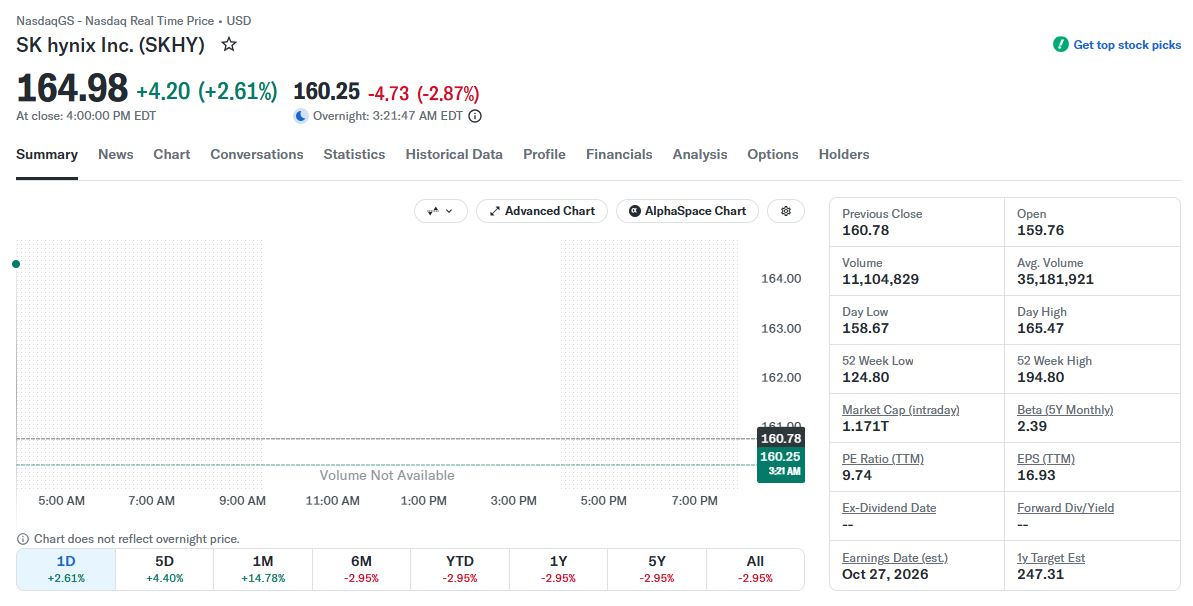
- SK Hynix
- Micron Technology
In particular, South Korea's SK Hynix holds strong competitiveness in the HBM space and is recognized as a market leader with a competitive edge. As the AI industry grows, investor interest in the HBM market continues to rise.
Samsung Electronics is also making strong pushes to leap forward and compete closely with SK Hynix.
Meanwhile, Micron is a familiar name to anyone with a passing interest in computers—often sought out as a cost-effective alternative when Samsung or SK Hynix memory prices run high.
Point 5. Future Outlook for the HBM Market
HBM technology is evaluated not just as a new memory product, but as a key driver transforming the entire semiconductor landscape.
With the expansion of the AI industry, the combination of GPUs and high-speed memory has become increasingly critical. In AI workloads, GPUs perform the heavy calculations while memory must supply data rapidly.
If memory speed lags behind during this process, overall computing performance drops. As a result, high-speed memory integrated with GPUs is becoming vital, positioning HBM as a core technology at the heart of this trend.
Recall one memorable news story from last year. The famous "Gganbu meeting"—where NVIDIA CEO Jensen Huang met with Samsung Chairman Jay Y. Lee and Hyundai Motor Chairman Euisun Chung for a casual chicken-and-beer gathering—perfectly highlighted the immense strategic importance of HBM.
As the AI industry continues to grow, demand for high-performance memory semiconductors will almost certainly rise alongside it. This is because AI technology relies heavily on faster data speeds and better efficiency.
Therefore, understanding HBM technology and market trends is essential for gaining a clear perspective on the broader semiconductor industry.
Conclusion
HBM semiconductors are a next-generation memory technology playing a pivotal role in the AI era.
Having a solid grasp of this technology will help you evaluate AI semiconductor companies and better interpret stock price trends.
Given the surge of interest in HBM driven by AI growth, understanding how this technology works will help you build your own clear investment criteria—just as I am doing here at 200Invest.
<Check Out More Articles on 200Invest>
What is an AI Data Center? Power Grids and Liquid Cooling Explained
What is an AI Data Center? Power Grids and Liquid Cooling Explained
Hello, this is 200Invest.These days, one of the most frequently mentioned terms in news and economic discussions is likely the "AI Data Center."We have all heard about data centers in the past. You might recall previous incidents where a fire at a data cen
200invest.tistory.com
Disclaimer: All content published on this blog is for informational and educational purposes only and reflects personal study notes. Nothing here constitutes a recommendation to buy or sell any financial asset. All investment decisions and financial risks rest solely with the individual investor.