
Hello, this is 200Invest.
These days, one of the most frequently mentioned terms in news and economic discussions is likely the "AI Data Center."
We have all heard about data centers in the past. You might recall previous incidents where a fire at a data center caused widespread system outages, disrupting services we use daily.
If traditional data centers could be compared to a library—essentially a storage facility for servers—the AI data centers making headlines today are far more than mere storage. They are living factories where vast amounts of knowledge are actively processed.
To put it simply, AI data centers are an indispensable backbone for using generative AI services like ChatGPT, Gemini, and Claude.
So, from a stock investor's perspective, what key insights should we understand about this space? Today, 200Invest breaks down what you need to know.
Point 1. The 2026 AI Data Center Outlook Through 200Invest's Lens: Moving Beyond AI Assistants to Autonomous Agents
AI data centers are packed with GPUs and HBM memory, both of which consume immense amounts of electric power.
By now, most investors are familiar with GPUs and HBM.
NVIDIA—led by CEO Jensen Huang, who recently drew major attention in Korea during the famous "Gganbu meeting"—is the primary manufacturer of GPUs.
Meanwhile, HBM memory produced by South Korean giants Samsung Electronics and SK Hynix is experiencing explosive worldwide demand.
Until recently, AI focused primarily on training models. Now, the market has officially entered the reasoning phase. As AI tools like ChatGPT and Gemini integrate into our daily lives, we are already relying on reasoning AI that answers global queries and drafts travel itineraries like a personal assistant.
Furthermore, Big Tech companies—including Google, OpenAI, and Apple—have begun releasing autonomous AI agents into the market.
What exactly is an AI agent?
While a reasoning AI acts as an assistant that generates a travel itinerary, an AI agent takes that authority one step further to directly book the hotel room on your behalf. Beyond casual tasks, AI agents are increasingly capable of replacing human workers in workplace duties.
For instance, you may have experienced AI taking over tasks previously handled by phone support reps or ARS systems at banks and shopping channels. That is a direct application of AI agent technology.
The deployment of these AI agents underscores the rapidly growing importance of AI data centers.
Unlike earlier models that only operated when a user asked a prompt, today's AI agents require continuous reasoning and constant external communications. As a result, maintaining these operations demands substantially higher power and advanced cooling systems to lower server temperatures. In short, high-performance AI data centers have become an absolute necessity.
Point 2. Infrastructure Essentials for Beginner Investors: Power Grids and Liquid Cooling
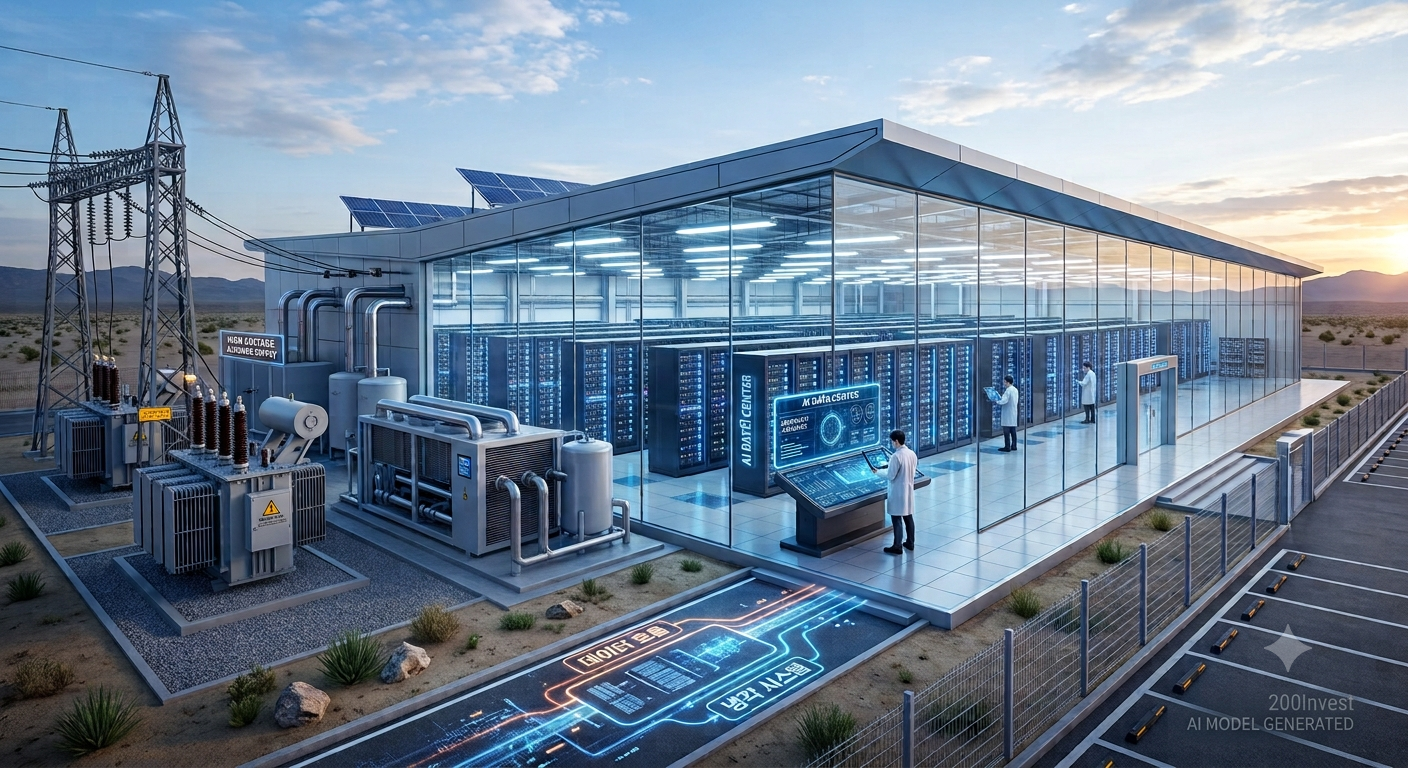
If wires in a traditional data center resemble household electrical wiring, those in an AI data center are more like massive high-voltage transmission lines.
When power is sent from external power plants to an AI data center, ultra-high-voltage transformers step it down to usable levels for the servers. A single AI server rack consumes 5 to 10 times more electricity than a traditional server rack.
As you can see, the power consumption is staggering.
This means that if power infrastructure is lacking, an AI data center cannot operate regardless of how advanced its hardware is. If AI is a car engine, the power grid is the fueling hose. Just as a thick hose is required to pump fuel rapidly, AI data centers rely on thick industrial high-voltage lines.
Another critical factor in daily computing is heat dissipation. When electronic devices overheat, they slow down, lose efficiency, or crash entirely.
Given the immense power consumed by AI data centers, the heat generated by these servers is almost unimaginable. Consequently, operators are deeply focused on finding optimal cooling solutions.
Air cooling, water cooling, and liquid immersion cooling are familiar terms if you have ever built a custom PC.
Air cooling uses fan units to blow air over components, but running these fans consumes additional electricity, making it less efficient. Water cooling pipes cold liquid directly over hot surfaces, but this approach reaches efficiency limits as heat levels rise.
Some companies have even explored extreme concepts, such as submerging data center modules directly into seawater to dissipate heat.
Currently, one of the most efficient solutions under spotlight is liquid immersion cooling. This technique directly submerges servers in non-conductive dielectric fluid, delivering the highest heat absorption capacity.
Ultimately, the future of AI data centers hinges on two key pillars: robust power infrastructure and advanced cooling technology. Facilities that fail to solve these challenges risk becoming obsolete.
Conclusion
Today, opinions remain split: about half the market believes widespread AI integration is still far off, while the other half views AI as an essential part of daily life.
At 200Invest, we strongly lean toward the latter view. AI is already deeply integrated into many aspects of modern life, and our investment approach moving forward will align with this trajectory.
Take time to formulate your own perspective on where the AI data center sector is headed. Establishing your own baseline will be invaluable for identifying key market trends ahead.
<Check Out More Articles on 200Invest>
What is HBM? A Beginner's Guide to AI Semiconductor Memory
What is HBM? A Beginner's Guide to AI Semiconductor Memory
Hello, this is 200Invest.Recently, one of the most frequently mentioned technologies in the AI semiconductor industry is HBM memory.As the AI industry grows rapidly, the need for faster and more efficient technology has become crucial, and HBM is drawing s
200invest.tistory.com
Disclaimer
All content published on this blog is for informational and educational purposes only and reflects personal study notes. Nothing here constitutes a recommendation to buy or sell any financial asset. All investment decisions and financial risks rest solely with the individual investor.